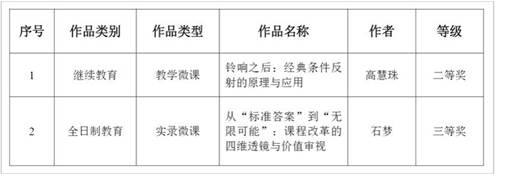
Recently, the results of the 2026 Jiangsu Provincial Higher Education Micro-Lecture Teaching Competition were officially announced, and two faculty members from our college stood out and achieved excellent results. Among them, Ms. Gao Huizhu won the second prize in the teaching micro lecture category of the continuing education group with her work After the Bell Rings: The Principles and Applications of Classical Conditioning, and Ms. Shi Meng won the third prize in the recorded micro lecture category of the full-time education group with her work From “Standard Answers” to “Infinite Possibilities”: The Four-Dimensional Lens and Value Review of Curriculum Reform.
The Jiangsu Provincial Higher Education Micro-Lecture Teaching Competition is hosted by the Jiangsu Association for Educational Informatization in Higher Education Institutions and is an important informatization teaching competition in the province. A total of 154 institutions across the province submitted 1,403 entries for this year’s competition. Following online expert review and conference re-examination, 937 award-winning works were selected, reflecting fierce competition. Since the launch of the competition, the college has attached great importance to it, actively mobilized and organized faculty to participate, and carefully carried out the selection and refinement of works, providing strong support for faculty to fully demonstrate their teaching strength in the competition.
In recent years, the college has continued to deepen the development of faculty teaching capabilities, focused on improving faculty information literacy and the level of informatization teaching innovation, and encouraged faculty to actively explore new teaching models and methods. These awards are not only a vivid reflection of the college’s achievements in classroom teaching reform and faculty team development, but also a microcosm of the college’s long-standing emphasis on improving teaching quality. Taking this competition as an opportunity, the college will focus on directions such as AI assisted instructional design, human-machine collaborative classrooms, and data driven teaching diagnosis, further promote the deep integration of artificial intelligence technology with education and teaching, support the construction of a high-quality talent cultivation system through educational digitalization, and continue to empower the comprehensive improvement of talent cultivation quality.


